
Portal Space
Here you will find a few projects I worked on while in Portal Space, as well as some of its history. For more information about Portal Space, please view their webpage.

Starting in Portal Space
While I officially only joined half a year after Portal was established, I had been working with the founders Rokas and Ola on their little adventures before they decided to start the organization with Marcus.
Portal was very green organization, but had a lot of inspired students willing to work towards a common goal; Building (maybe) Norway's first bi-liquid rocket engine. Since the organization lacked money and this was the same time the first Covid lockdown happened, it didn't take long for most members to leave. After only a few months, we were only five members left, namely Eirik, Even, Ola, Rokas, and myself. While unable to work at our university campus due to the lockdown we had to find other places to work. Ironically we also soon received a grant from Sparebankstiftelsen DNB which was time bound. Luckily we found someone who had the space and interest in hosting our shenanigans, Kåre Kristoffersen. Kåre had a big farm with lots of cabins, space, and most importantly it was remote. It was a new adventure for the organization, and it was the place we built and successfully tested our first rocket engine.

A cabin in the woods of Sørkedalen. The first
engine was named Reodor from Flåklypa Grand Prix as the vehicle created in the movie features two
liquid fueled rocket engines. Similarly the engine we created was also ethanol fueled, and the setting is uncanny

Burnt out engine

Sørkedalen is remote

Co-founder Rokas during the
time before Portal was established
My time in Sørkedalen
By the few members who witnessed Sørkedalen, the description of it is more along the line of a state of being rather than a place. While it was only the five of us who truly "went through Sørkedalen", we did go back there after our first recruitment, with not much to show for.
Sørkedalen was a bit like being in the army. You mostly have fond memories of it, but at the time it wasn't always that fun. Most of the time spent there were filled with long hard working days, both physically and mentally. In the spring it wasn't especially warm either, which is always fun when working with a lot of water to check the plumbing of the engine. With an underpowered power connection and a lot of power hungry tools such as a welder, the light would dim during the power surges at night. The mice and flies didn't make the summer times any better, and with an exceptionally hot summer, being outside was a chore in itself. We did however manage to build a working engine.
Since we were so few, it didn't take long before we had our own little clan-lingo, one that we worked hard to get rid of when we first started recruiting new members. We also naturally found our own specialties, which would later become departments in a bigger organization. Since we wanted to build everything ourselves, we ordered a CNC with most of our budget. Rokas became the main CNC machinist, Even spent most of his time with machining and 3D printing. Ola focused on plumbing and combustion chamber, while Eirik focused on plumbing with his bachelors in process technology, and later also the new interface. I myself became the electronics guy, in charge of controlling the engine and logging data.
While not much had happened before Sørkedalen, most of the design was "well established" before we got the money and place to start making the engine. That included the decision to use the Arduino compatible Teensy platform for data acquisition and control; A decision I wasn't overly excited about. Regardless a circuit, or rather several small modules was made. Most of these modules were for the different parts of the engine, and the Teensy would get data and control the engine, which was soon given its proper name - Engine Control Unit (ECU). Since most of the sensors and actuators were not directly compatible (and since they were already bought from beforehand) a lot of work went into making what in theory should be pretty straightforward. The ECU consisted of five voltage domains: 3.3V, 5V, 15V, 24V, and for some reason 230VAC. The latter of which made the ECU rather dangerous for those unknowing. Luckily it was only me at this point in time, and clear instructions were (probably) given when someone else had to meddle with the circuits while I was away.
While the Teensy did give the possibility of using a high end microcontroller, the pros soon outweighed the cons. While the first interface was based on a server hosted by the Teensy on our local network, the software soon started to break bit by bit. Soon, so did the hardware, and I vowed never to touch Arduino again and made a new ECU with a proper printed circuit board and my trusty old AVRs. While I was still stuck with the same sensors and actuators (and by extension voltage domains) I managed to design and order the new power supply and ECU over a weekend. With the new ECU received and soldered, testing was next on the agenda. At this point summer was closing in fast, and so was our vacation plans. With a few completely sober all-nighters, the humongous spaghetti code was done and ready. At this point most of the engine was also miraculously built by the other members, and testing started.
The mighty BaByliss Paris Expert 2200 (hair dryer) was our true savior during our time testing. With standard rated valves and cryogenic oxidizer (Liquid oxygen), the valves had the habit of freezing in unwanted positions. With some duct tape, the BaByliss aimed at the main oxygen valve, haste, and a bit of luck, we successfully started the rocket engine in July 2021.

Capacitance meter

Solenoid drivers
Parts of the teensy based proto-ECU


Hazardous materials
Eirik and myself

Analog front-end

Fully combusted, combustion chamber
Main character Even Tobais - ET
Checking plumbing
Rokas and myself
Tightening what should not be loose
Ola and Eirik


That one frame
sAViR of Sørkedalen
PSU and first proper ECU

The mighty BaByliss

Hazardous environment
Rokas, myself, and Ola in the background


Field repair of a Teensy
Injector plate(s)
Building an organization
After returning from our vacation the very same summer we had our first successful engine test we started planning our expansion. The final parts of the summer was spent making Portal Space as a new organization, and a lot of time was spent making the hierarchy and organizational structure. We adopted the most common company structure with a board, management, and departments. While the board in reality didn't really exist (only CEO), the technical aspects of the organization was soon well organized. The organization would have four departments; Structures, Propulsion, Electronics, and Operations. The latter would soon be disbanded, then re-established later. Structures was to be lead by Even, propulsion by Rokas which also became CTO, Ola became CEO, and I became the electronics lead. Eirik had just finished his education and therefore became an advisor instead (he later rejoined). In addition to this the university started taking interest in our project, and we soon got access to a workplace at the university as well as a workshop we could store and use our tools in.
With the structure of a company and the attitude of a company (without the wages), we also decided that new members should go through interviews to be able to join, followed by an onboarding session. The interviews were in two parts, with one culture fit, and one technical. The first wave of new members was a rather large one, but I myself only wanted to recruit a maximum of two members for the Electronics department. In hindsight it would probably have been better if I took on a few more. With the new members in hand we immediately went back to Sørkedalen to show these rookies what a rocket engine is. We couldn't have failed more depressingly. Spending a few long and cold days trying to recreate our success. After a bitter defeat a new plan was set forth, one that would see an attempt at redesigning parts of the engine, as well as defining and starting projects that would see a complete rocket made.

Every new member must learn to solder
by my decree

At least we had the time to take
pictures the second time around in
Sørkedalen
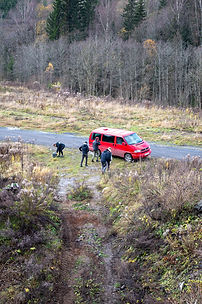
Baronen (the red baron) is called
to action yet again

The second time was like T -
water with little taste

Electronics high level design 2021


Electronics high level design 2022
Electronics high level design 2023

New electronics department
lead after I left
Building a rocket
Things really started getting going in 2022, and we also got a new place to test our engines by the university at ITS, Kjeller. It didn't take long for another recruitment period to happen, and with a lot of new members we could finally start focusing on more than just the rocket engine. The goal was to join a rocketry competition in fall the very same year, so the following spring and summer was very hectic.
I worked on a lot of different different projects during my time in Portal. While most of the time went into managing and participating in tests, I did have the opportunity to make many of the parts used in the rocket myself, as well as making the overall electrical design of what modules was needed, and what they should do.
The ECU was a particularly important module. What is a rocket if not an engine? While there were several iterations they slowly became more streamlined. The main task of the ECU was to gather sensor data such as pressure, temperature, and thrust, as well as controlling the valves and ignition of the engine. While most of the valves were controlled by simple solenoids, the main valves for propellant and oxidizer needed to be adjustable to control the flow to the injectors. The main oxygen valve was a particularly challenging task, and was one I spent some time on. While there had been many iterations of the Main Oxygen Valve (MOV), only a handful were actually serious. The first five or so iterations were for the most part a few idea mock-ups from Sørkedalen. The last three however were rather serious, and I was responsible for creating the electronics. The challenge is that the torque can be very high (measured up to 25Nm), so gearing is a must. In addition it is preferred that the valve is neither too fast nor too slow, as it is important to have a quick reaction, but smooth movements during engine pre-staging.
Other noteworthy projects I did was building the communication modules, which was a dual band transceiver at 433 MHz and 2.4 GHz with a simple UART interface. I also made some of the power supplies, a few different sensors, and communication modules between the different modules of the rocket.
While we ultimately didn't manage to get the rocket ready in time for the rocketry competition we did manage to have many successful engine tests with many different engine modifications and combustion chamber designs.

That container isn't going to be white
for long..

Getting ready for a shot at rocketry

ECU V3

Dual band transceiver

Successful engine test
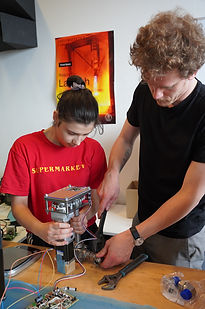

MOV with prototype driver
Mission control during engine testing


That frame
Members during spring 2022
The end times
While my time in Portal was a fun, I couldn't be there forever. While most of the "veterans" slowly moved on, I stayed for a little while longer to make sure that those who were supposed to take over didn't have to reinvent everything. Regardless, I myself found that I had done what I wanted to do in this project, and that it was time to move on to new projects. After handing over my position as electronics lead to a promising candidate, I went on to become an advisor. I occasionally help Portal with reviews and workshops, and I look forward to see what the new Portal Space will do.

Bipolar power stepper driver